


#908 The Shield of the Trinity
October 6, 2024Dr. Craig, in your opinion, is The Shield of the Trinity (Scutum Fidei) a valid Trinitarian diagram?
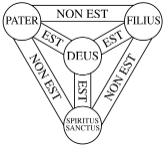
The famous Trinitarian triangle where “The Father”, “The Son”, “The Spirit” are at the corners and “God” is at the center connected to all three by “is”.
You have said: … only the Trinity is God. … while the statement “The Trinity is God” is an identity statement, statements about the persons like “The Father is God” are not identity statements.
So you would replace “God” with “The Trinity”, but then you have “The Father is The Trinity” and “The Trinity is The Father” etc.
I have not yet heard your thoughts on the diagram so could you clarify them for us.
Philip
 United States

Dr. craig’s response
A
The utility of this arresting diagram all depends, Philip, as Bill Clinton once said, on what the meaning of the word “is” (est) is.
When one says that the Father is not the Son and the Son is not the Spirit and the Spirit is not the Father, one is using the word “is” in the sense of identity (e.g., “Mark Twain is Samuel Clemens” is an identity statement). The diagram thus indicates that there are three distinct persons.
But then in that sense one cannot coherently affirm that each of the three persons is God (Deus). For the logical relation of identity requires that if the Father is identical to God and the Son is identical to God, then the Father is identical to the Son, which the diagram denies. It would do no good to substitute the word “Trinity” (Trinitas) for “God” (Deus), not only because the Father would then be identical to the Trinity, which is false, but because the logical relation of identity would still then require the Father to be identical to the Son.
What becomes evident is that when the diagram states that each person “est Deus,” the word “est” does not express the identity relation. Rather this is the “is” of predication, as when we say, “The dog is brown” or “Biden is President.” We are not making an identity statement, but predicating a property of a subject. So Trinitarians have not understood statements like “The Father is God” to be identity statements. The central failure of unitarians is construing such statements as identity statements. Rather, they are predications meaning something like “The Father is divine.”
Because the diagram does not signal the fact that the word “est” is being used in two different senses, it is potentially very misleading. Perhaps the diagram should have signaled this difference by “est1” and “est2”. So long as we do not conflate these two senses of the word “is,” the diagram can be useful.
- William Lane Craig